A National Survey of IEP Quality in Preschool
The purpose of this study is to determine whether or not there are significant differences
in the quality of preschool IEP goals and objectives across the US, and if
there are, what factors influence those differences. The
Revised IFSP/IEP Goals and Objectives Rating Instrument (R-GORI,
Pretti-Frontczak, 2004) will be used to evaluate the quality of the sample
preschool IEP goals and objectives. Using
a stratified random sampling technique, local education agencies (LEA) that
serve preschool children who are eligible for special education services under
IDEIA, 2004 will be identified in states
that represent each of the census regions of the United States.
Each LEA will be asked to forward
the link to the online survey to the relevant preschool special education
personnel. The
final sample is expected to have minimum cell sizes of 30 at the state level to
allow for statistical analysis. Ms. Hubbell is the principal investigator of this study and but has several collaborators as well.
Evidence Base for Commonly-Used Assessments in Early Childhood
This literature review and analysis completed in collaboration with Teresa Brown, identified the currently available evidence base for eleven commonly-used assessments in early childhood and early childhood special education settings. The results indicated inadequate research on the technical adequacy and utility of most of the assessments reviewed. The original report is available for download.
In an effort to
strengthen the analysis, the review was replicated with more strict criteria
for inclusion and exclusion of assessments and evidence. The results of the replication were presented
as a session at the Division for Early Childhood Annual Conference in October,
2010. A summary of the evaluations completed by the session participants is available here.
The Effects of a Peer-Mediated Social Story Intervention
Delivered via Interactive White Board on Social
Engagement of Preschoolers
with Autism Spectrum Disorders
This single-subject design study was conceptualized in collaboration with Dr. Sanna Harjusola-Webb and conducted during the spring semester 2010. The purpose of the intervention was to increase the social engagement of preschoolers with autism spectrum disorders during play with typically developing peers. For this study, social engagement was defined as an initiation or response towards a peer, or turn-taking with a peer. An initiation or response in the form of a word, a phrase, a sentence, a vocalization, or a gesture was accepted. Turn-taking was further defined as two or more initiation/response combinations on the part of one child (i.e. initiation-target child, response-peer, response-target child). The dependent variables were measured using the Language Environment Analysis (LENA) system and observational coding of video-recorded sessions. The results were presented as a poster at the Division for Early Childhood Annual Conference in October, 2010.
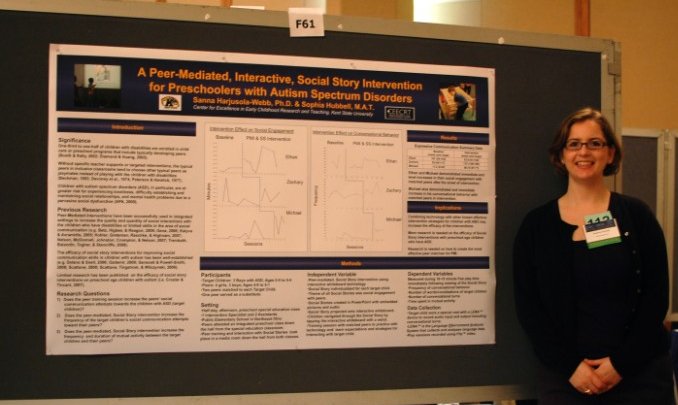 | Ms. Hubbell presenting her poster at the Division for Early Childhood Annual Conference in Kansas City, October 2010. |
